Crude oil is one of the most volatile and emotionally driven markets in the world. In early 2026, Brent crude surged from $73 to above $110 per barrel in weeks — then reversed sharply. Traders who followed the headlines lost money. Traders who read the sentiment data saw the turn coming.
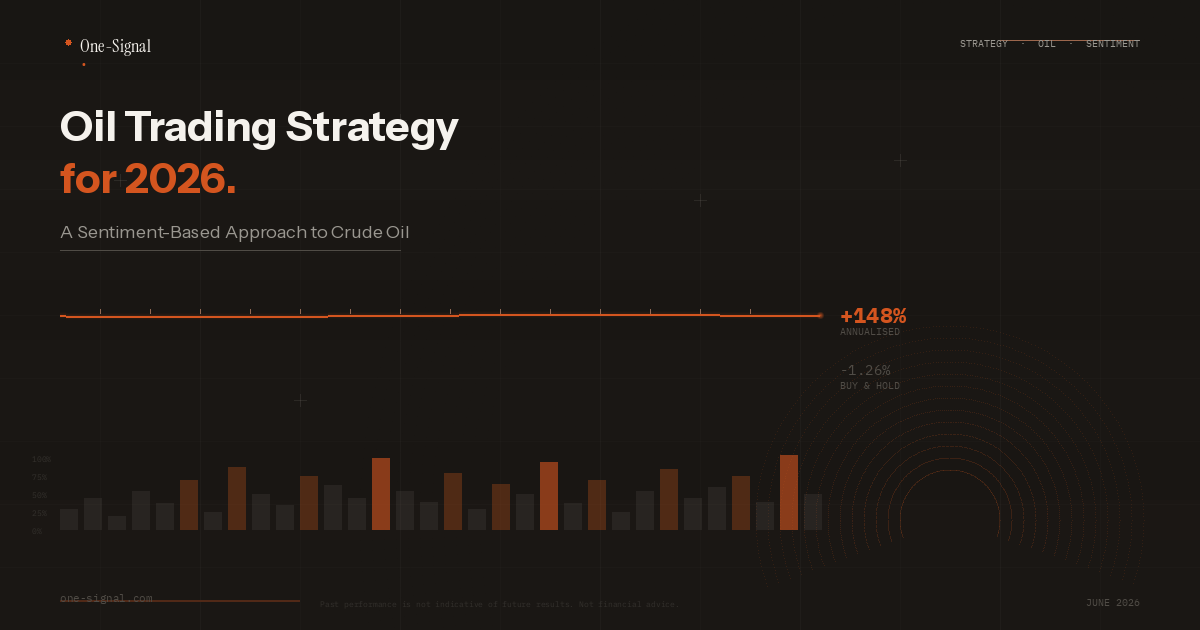
This guide breaks down how to trade oil in 2026 using a sentiment-based approach — one that has delivered 148% annualised returns over the past five years at ONE-SIGNAL, compared to a -1.26% return for a buy-and-hold crude oil futures position over the same period.
The difference isn't luck. It's methodology.
Why Oil Is Uniquely Suited to Sentiment-Based Trading
Oil prices are driven by three forces: supply (OPEC+ decisions, US production), demand (global growth, China consumption), and emotion (geopolitical fear, speculative positioning).
Of these three, emotion moves faster and more violently than the fundamentals ever do. The 2026 Iran-Hormuz crisis is a textbook example: the physical supply of oil didn't change overnight, but the fear of supply disruption sent prices up 50% in weeks.
This is exactly where sentiment analysis excels. Technical indicators like RSI and moving averages tell you what oil has already done. Fundamental analysis tells you what oil should be worth based on supply and demand models. Sentiment analysis tells you what traders are feeling right now — and whether that feeling has become extreme enough to reverse.
When fear reaches a measurable extreme, prices are likely to correct downward. When complacency sets in after a long decline, the stage is set for a bounce. These aren't opinions — they're patterns that repeat across decades of oil market data.
The Three Sentiment Indicators That Matter for Oil Trading
1. Commitment of Traders (COT) Report
The COT report, published weekly by the CFTC, shows the net positioning of three groups: commercial hedgers (oil companies), large speculators (hedge funds), and small speculators (retail traders).
For oil trading, the signal comes from speculative positioning extremes. When hedge funds hold their largest net-long position in crude oil futures in months, it means the bullish trade is crowded. Historically, extreme speculative long positions in oil precede price drops — not because the hedge funds are wrong, but because there's no one left to buy.
The reverse applies equally. When speculators hold extreme net-short positions, the bearish trade is crowded, and a squeeze becomes likely.
2. Implied Volatility (OVX)
The OVX — sometimes called the "oil VIX" — measures implied volatility in crude oil options. High OVX readings indicate fear and uncertainty. Low readings indicate complacency.
Counterintuitively, high OVX readings often appear after oil has already fallen sharply, making them a potential contrarian buy signal rather than a sell signal. The fear has already been priced in. What follows is often a mean-reversion rally.
3. Geopolitical Sentiment Gauges
Unlike gold or equities, oil is uniquely exposed to geopolitical risk. Strait of Hormuz tensions, OPEC+ production decisions, and sanctions can move prices by 5-10% in a single session.
A sentiment-based approach doesn't try to predict geopolitical events. Instead, it measures how much geopolitical fear is already embedded in the price. When oil is trading at $110 and every headline screams "supply crisis," the fear is priced in. The asymmetry shifts: a de-escalation will push prices down hard, while further escalation has diminishing impact.
A Practical Oil Trading Framework for 2026
Entry Rules
- Identify the sentiment extreme. Check the COT report for speculative positioning. If net-long positioning is above the 90th percentile of the past year, the market is crowded long. If below the 10th percentile, it's crowded short.
- Confirm with volatility. If OVX is elevated (above 35) and oil has already declined 10%+, the fear is priced in. If OVX is low (below 20) after a sustained rally, complacency has set in.
- Wait for the signal. At ONE-SIGNAL, we don't trade on sentiment alone. We wait for the sentiment data to align with a quantified signal — a specific directional call (LONG or SHORT) with defined entry, exit, and stop-loss levels.
Exit Rules
Every trade has three possible exits:
- Target hit. The price reaches the defined exit level.
- Stop-loss hit. The price reaches the defined stop-loss level. This limits the downside on any single trade.
- Reversal signal. A new signal in the opposite direction replaces the current position.
This framework removes discretion from the process. You don't have to decide whether to hold or exit during a volatile session — the system has already defined the parameters.
Risk Management
Oil's volatility makes risk management non-negotiable. A 5% daily move in crude oil is not unusual during geopolitical events.
The key principles:
- Position sizing. Never risk more than 2-4% of your trading capital on a single oil trade.
- Stop losses on every trade. No exceptions. ONE-SIGNAL includes a stop-loss with every signal.
- Don't double down on losing positions. If the trade is going against you and hasn't hit the stop, don't add to it. The sentiment data that triggered the entry may still be valid, but adding risk compounds the potential loss.
How ONE-SIGNAL Trades Oil: The Track Record
ONE-SIGNAL has been generating daily oil trading signals since 2020. The approach is systematic: one signal per day — LONG or SHORT — with defined entry, exit, and stop-loss levels. No discretion. No market commentary. Just a clear directional call.
The results speak for themselves:
Oil performance (annualised, 2020-2025):
- Oil futures buy-and-hold: -1.26% annualised
- ONE-SIGNAL Oil signals: +148.40% annualised
2025 performance:
- Oil futures: -19.99%
- ONE-SIGNAL Oil: +48.88%
Oil was one of the worst-performing assets in 2025 for passive holders. It was one of the best for ONE-SIGNAL subscribers. The difference is that a sentiment-based system doesn't care about direction — it trades both long and short based on where the data points.
Past performance is not indicative of future results. These figures are for informational purposes only and do not constitute financial advice.
Common Mistakes in Oil Trading
1. Trading the Headlines
When the Strait of Hormuz tension spiked in March 2026, many traders went long on oil expecting further escalation. Oil had already priced in the worst-case scenario. When tensions de-escalated slightly, oil dropped 15% in three sessions. Headline traders were caught on the wrong side.
Sentiment data would have flagged the extreme: speculative long positioning was in the 95th percentile, OVX was elevated, and the price had already moved up 50%. The setup was for a reversal, not a continuation.
2. Ignoring Stop Losses
Oil can move 3-5% in a single session. Without a stop loss, a small loss becomes an account-damaging event. Every ONE-SIGNAL trade includes a defined stop loss precisely because oil's volatility demands it.
3. Trying to Predict OPEC Decisions
OPEC+ meetings are among the most unpredictable events in financial markets. Even OPEC members themselves change their minds during meetings. Trying to position ahead of an OPEC decision is gambling, not trading.
A sentiment-based approach waits for the market's reaction to the decision, then reads whether the reaction has created a tradable sentiment extreme. The edge comes from reading the crowd, not predicting the event.
4. Overcomplicating the Analysis
Oil markets attract technical analysts who layer dozens of indicators on their charts — Fibonacci levels, Bollinger bands, MACD, RSI, Ichimoku clouds. The result is analysis paralysis.
A simpler approach works better: read the sentiment data, follow the signal, manage the risk. Complexity is not correlated with profitability.
Oil Trading Instruments: How to Access Crude Oil Markets
There are several ways to trade oil, each with different risk profiles:
- Futures contracts (CL): The most direct way to trade crude oil. High leverage, high liquidity, requires a futures-enabled brokerage account. ONE-SIGNAL's oil signals are referenced to futures pricing.
- ETFs (USO, BNO): Exchange-traded funds that track oil prices. Easier to access than futures, available in standard brokerage accounts. However, ETFs can suffer from contango drag — a structural cost from rolling futures contracts — that erodes returns over time.
- CFDs: Contracts for difference offered by many online brokers. Provide leverage without the complexity of futures. Available globally, though not in all jurisdictions.
- Oil company stocks: An indirect way to gain oil exposure. Oil stocks don't track crude oil prices perfectly — they're also affected by company-specific factors like debt, production costs, and management.
For most ONE-SIGNAL subscribers, CFDs or futures are the preferred instruments because they allow both long and short positions and closely track the underlying oil price.
Past performance is not indicative of future results. This content is for informational purposes only and does not constitute financial advice.