Most retail traders pick stocks. Most retail traders lose money. These two facts are not unrelated.
In 30+ years of trading, I've watched the same pattern repeat: a trader picks a stock, watches it intensely, holds too long when it drops, sells too early when it rises, and ends the year underperforming an index they could have bought passively. Then they pick another stock and start again.
The problem isn't the trader. The problem is the structure of stock-picking itself.
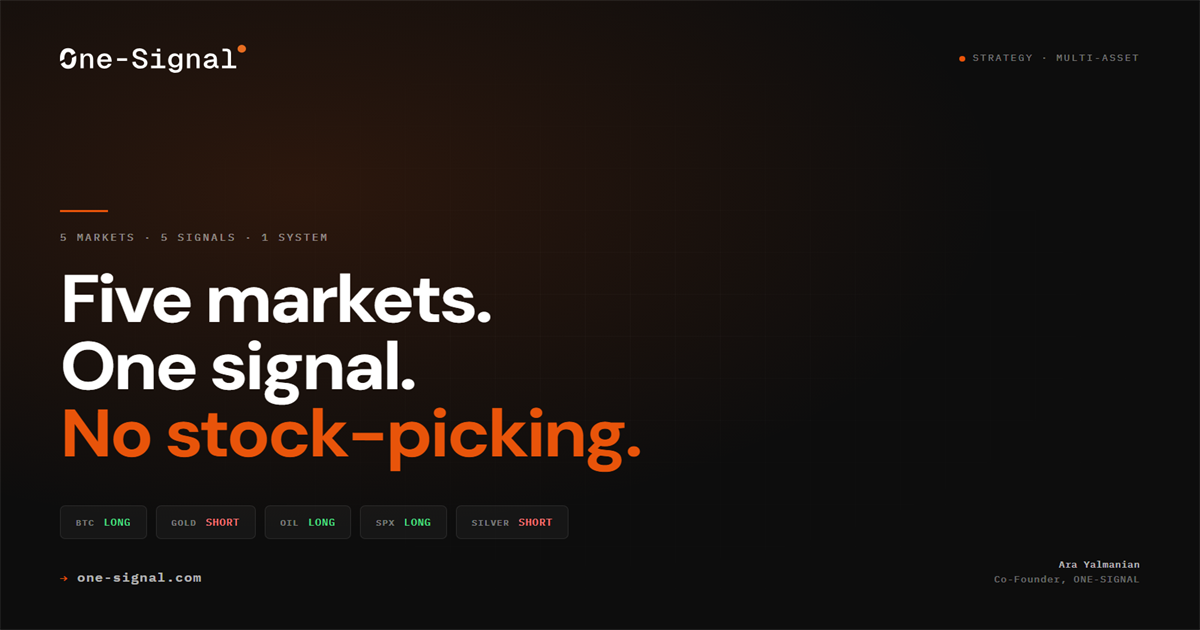
This article makes the case for a different approach: trading one systematic signal across multiple uncorrelated assets, instead of trying to pick winners within a single asset class. It's the framework behind ONE-SIGNAL, and the rationale for why we cover Gold, Silver, Oil, S&P 500 and Bitcoin — five assets, five distinct markets, one signal logic.
The structural problem with stock-picking
Stock-picking has three structural problems that very few retail traders ever fully reckon with.
Problem 1: The math is brutal. Roughly 4% of US stocks accounted for all of the net stock market wealth created over the past 100 years (Bessembinder, 2018). The other 96% either matched cash or destroyed capital. To win as a stock-picker, you don't just need to be right — you need to be in that 4%. Statistically, picking five stocks gives you almost no probability of catching the next NVIDIA. It gives you a much higher probability of holding the next Lehman.
Problem 2: Your edge is microscopic. Whatever insight you have on a given stock, professional analysts have it too — with better data, faster execution, and full-time focus. The retail edge in single-stock picking ranges from "small" to "nonexistent" depending on the name.
Problem 3: Concentration risk masquerades as conviction. Holding five stocks feels diversified. It isn't. Five US large-caps in 2022 all dropped 20–40% together. Five tech names in early 2025 all rerated together. Within an asset class, correlations spike during the exact moments you most need diversification.
None of this means stocks are bad. It means stock-picking is a low-edge, high-correlation strategy built on a flawed premise — that you can outpredict the market on individual names without institutional infrastructure.
What multi-asset trading actually means
Multi-asset trading replaces "which stock will go up?" with a different question: "which direction will this whole market move today?"
Instead of betting on the winner within an asset class, you bet on the direction of the asset class itself. Gold up or down. Oil up or down. SPX up or down. The bet is broader, the signal is systematic, and the asset selection is given — you don't pick winners, you trade defined markets.
The result: you're no longer competing against analysts who know more about Apple than you ever will. You're competing against the structural inefficiencies of how positioning, sentiment, and flow play out across whole markets — territory where systematic methods have an edge.
This is what daily directional trading signals look like in practice. Not "buy NVDA at $X." Instead: "Gold LONG today, entry at NYSE open, exit at NYSE close, stop at −1.5%."
Why 5 assets across 5 classes is mathematically better than 5 stocks
Five stocks within US equities give you one factor exposure: US equity market beta. When the market drops, all five drop. The diversification is illusion.
Five assets across five classes — Gold (precious metal, monetary), Silver (precious + industrial), Oil (energy commodity, macro-cyclical), S&P 500 (US equity benchmark), Bitcoin (digital asset, risk-on alt) — give you something different. These markets are genuinely uncorrelated to each other in most regimes:
- Gold and SPX have averaged a correlation of around 0.0 to −0.2 over rolling 5-year windows
- Oil and Bitcoin are largely independent of each other
- Silver tracks Gold but adds industrial demand (a different driver)
- Bitcoin behaves like a high-beta risk asset but with its own positioning dynamics
When you have five genuinely uncorrelated bets, your portfolio Sharpe ratio improves mechanically — even if the edge on each individual bet is identical. That's the textbook result, and it's why institutional managers obsess over correlation, not selection.
For a retail trader, the practical implication is enormous. A losing Gold day doesn't drag down your Bitcoin position. A drawdown on the SPX signal doesn't compound across the rest of your book. Risk is genuinely distributed.
How daily directional signals change the math further
Adding a daily time horizon — entry at NYSE open, exit at NYSE close — does something subtle but important.
Long-hold strategies depend on getting direction and timing right. Buy gold and hold for 2 years: you need gold to be in a multi-year uptrend, and you need to not flinch through drawdowns. Most retail traders fail on the second part.
Daily directional signals only need to get today's direction right. Tomorrow is a fresh decision. There's no compounding of conviction error. There's no overnight tape risk. Each trade is an independent bet with a defined payoff and a defined loss cap.
Across five assets, that's five independent bets per day, each with its own positioning logic. The law of large numbers starts working in your favor — small statistical edges compound across enough trials to produce meaningful results.
ONE-SIGNAL's track record across the five assets reflects this:
- Bitcoin signals: +187.84% annualised vs +65.81% buy-and-hold (2020–2025, self-reported)
- Crude Oil signals: +148.40% vs −1.26% buy-and-hold
- S&P 500 signals: +22.80% vs +16.34% buy-and-hold
- Silver signals: +27.62% (vs +31.36% buy-and-hold — system underperformed)
- Gold signals: +19.25% (vs +23.23% buy-and-hold — system underperformed)
Two assets where the system underperformed buy-and-hold are published in the same table as the three where it didn't. That's the whole point of transparent performance reporting. Methodologies that hide their losers shouldn't be trusted.
Why these five markets specifically
The five assets ONE-SIGNAL covers weren't chosen because they're popular. They were chosen because each one is:
- Deep and liquid — executable through any standard broker without slippage concerns
- Genuinely uncorrelated to the others — diversification is structural, not cosmetic
- Heavily positioned by retail and institutional speculators — sentiment data exists and is meaningful
- Tradeable in multiple instruments — futures, ETFs, CFDs, mini-futures (you pick what fits your jurisdiction)
- Active during the NYSE window — the trading day the methodology is built around
This is why we don't cover bonds (positioning data is thinner, retail flow is small), individual stocks (no edge vs analysts), or exotic FX (manipulation risk). The five we cover are the densest universe of independently tradeable markets a systematic methodology can reasonably address.
The execution edge: same broker, different instruments
A practical advantage of the multi-asset approach: every signal is executable through the same broker account.
With a standard broker you can trade:
- Gold via futures (GC, MGC) or the GLD ETF
- Silver via futures (SI, SIL) or SLV
- Oil via WTI futures or USO
- S&P 500 via futures (ES, MES) or SPY
- Bitcoin via spot, perpetual futures, BTC ETFs, or CFDs (depending on jurisdiction)
Five markets. One broker. One account. One workflow.
Compare that to the friction of running five different stock-picking strategies — fundamental analysis, position sizing, news monitoring, earnings tracking — each requiring its own research process. Multi-asset systematic trading collapses all of that into a single decision per asset per day.
When multi-asset doesn't help
Multi-asset trading isn't a panacea. The approach struggles in two specific scenarios:
Correlation crashes. In severe liquidity events (March 2020, late 2008), all assets briefly correlate to one — usually the dollar. Diversification temporarily disappears. Defined stop losses are the only protection in those windows.
Trending regimes that favor passive holding. When an asset is in a clean multi-year uptrend, daily systematic trading often underperforms simple buy-and-hold. Gold's 2024–2025 cycle is the recent example — passive holding beat the system. The compensation is structural: defined risk, no overnight exposure, no emotional drawdown management.
These limitations are real and worth knowing. The system's value isn't "always wins" — it's "always defines risk, always has an exit plan, always works the same way regardless of headlines."
Why this matters for retail traders
The retail trader who stops picking stocks and starts trading systematic signals across uncorrelated assets is making three structural improvements simultaneously:
- Smaller information disadvantage — competing on positioning math, not on knowing more about a company than analysts
- Genuine diversification — five real, uncorrelated bets instead of five flavors of the same bet
- Defined risk per trade — every signal has an entry, exit, and stop, which removes the holding-too-long failure mode
None of these improvements eliminate risk. Trading is risky. But they replace soft, narrative-driven decisions with hard, mechanical ones — and over enough trades, that's what differentiates traders who compound from traders who churn their accounts.
If you want to see what this looks like in practice, browse the ONE-SIGNAL plans starting at $49/month. Each plan delivers one daily signal per asset, with defined entry, exit, and stop loss, before the NYSE open.
Past performance is not indicative of future results. ONE-SIGNAL provides informational content only — not financial advice, portfolio recommendations, or personalized trading guidance. Trading involves risk and you may lose capital. Always consult a licensed financial advisor before making investment decisions.